
A practical checklist for writing a request for quote that suppliers can price without guessing: drawing, thread, knurl, material, plastic, documents and commercial terms.
Short answer: A good brass insert RFQ contains a dimensioned drawing, the brass grade, the thread callout, the knurl description, the target plastic and molding process, the destination market with the documents it needs, and the quantities and delivery terms. Tolerances belong on the drawing, not in the email. Send the same package to every supplier so the quotes compare line by line, and ask for samples before the production order.
Key Takeaways
- Suppliers can only price what they can see, so the drawing is the center of the RFQ and every other field supports it.
- “Brass insert” is not a specification. Write the grade, the thread standard, the knurl and the target plastic.
- The thread callout must name the standard, because ISO 7-1 and ISO 228-1 describe different jobs for a thread.
- Destination market decides which material documents you need, so state it up front.
- Identical RFQs produce comparable quotes, and samples tested in your own molding trial close the loop.
What belongs in a brass insert RFQ?
An RFQ for brass inserts needs eight items, and the drawing is the most important one. The table lists each field, what to write, and why the supplier needs it.
| Field | What to write | Why it matters |
|---|---|---|
| Drawing | PDF drawing with dimensions, plus a 3D file if you have one | Sets geometry, cost and tooling |
| Tolerances | Marked on the drawing; write “per drawing” in the email | Drives machining cost and inspection |
| Thread | Standard, size, and internal or external | Prevents a wrong-thread shipment |
| Knurl | Pattern, area and any anti-rotation or anti-pull-out features | Controls anchoring in the plastic |
| Material and finish | Grade with designation, and surface condition | Determines price, corrosion behavior and documents |
| Plastic and process | PPR, PE, CPVC or PPSU, and molded-in installation | Sets the knurl and the retention requirement |
| Market and documents | Destination country and the certificates or records you need | Decides the grade and the paperwork |
| Commercial terms | Quantity per size, annual volume, packaging, Incoterm, port | Makes quotes comparable |
Send these as one package. Suppliers who receive half the information quote against their own assumptions, and you cannot compare their numbers afterwards.
Which drawing details do suppliers need?
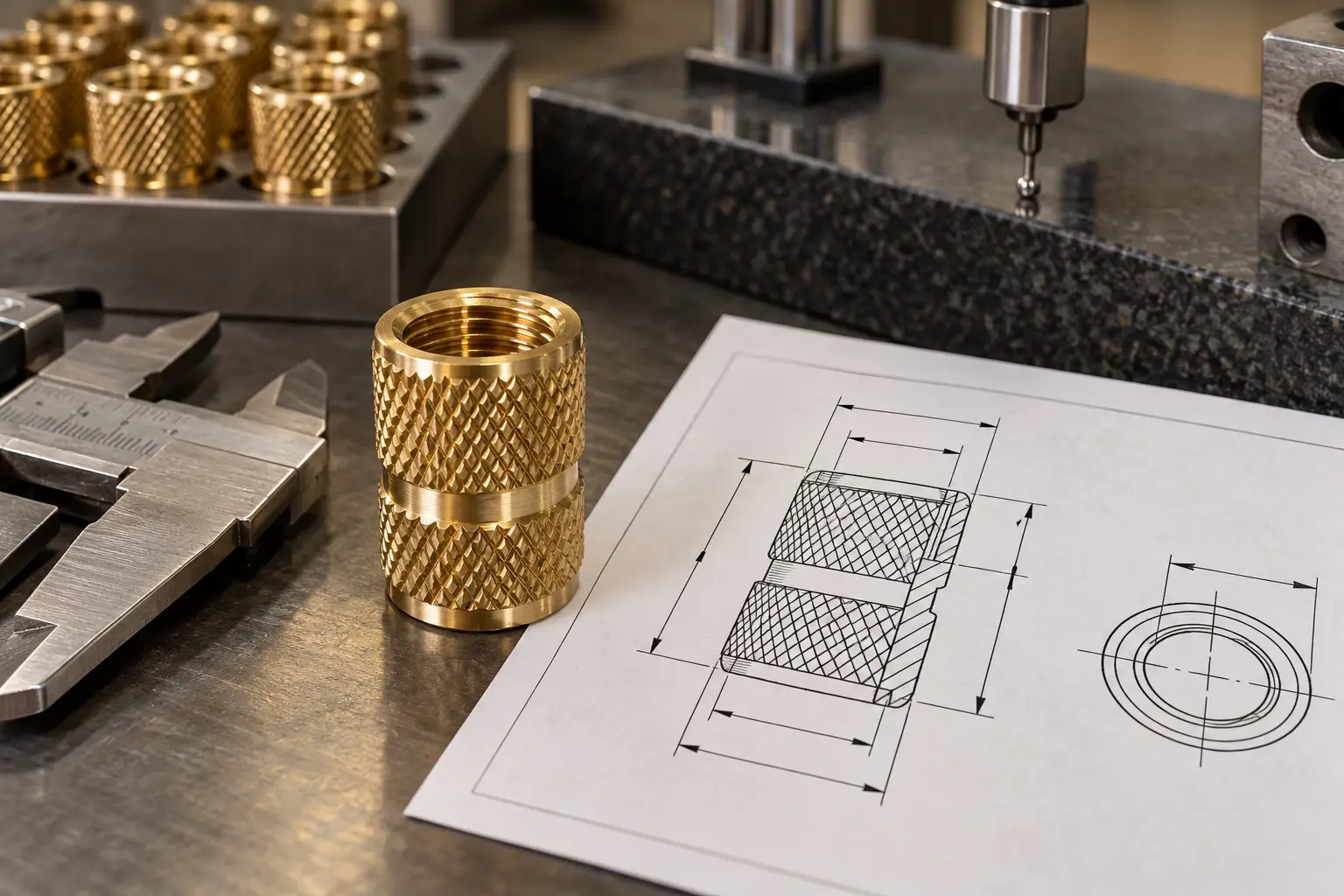
Suppliers need a dimensioned drawing that shows the insert as it is made, not a catalog photo. A complete drawing carries the following information:
- Overall dimensions: outer diameter, length, and any shoulder or flange.
- Bore and thread: bore size, thread callout and thread depth for the internal or external thread.
- Anchoring features: knurl area, grooves and any undercut that locks the insert in the plastic.
- Tolerances and critical features: write them on the drawing so the supplier can quote against them.
- Revision and part number: keeps quotes, samples and orders tied to the same version.
Write “tolerances per drawing” in the RFQ text and leave the numbers on the drawing, where inspection also reads them. Fenilo does not publish generic tolerance values, because the right value depends on the part and the molding process, and it is confirmed against your drawing.
How do you specify the thread?
Name the thread standard, not just the size, because the same nominal size can describe different threads. Two ISO standards cause most confusion for brass inserts in water fittings:
- ISO 7-1: specifies thread form, dimensions, tolerances and designation for jointing pipe threads, where the seal is made on the thread. Mating threads are taper external with parallel internal, or taper internal.
- ISO 228-1: covers pipe threads for mechanical assembly of fittings, cocks and valves, which are not suitable as jointing threads where the seal is made on the thread.
- NPT and other regional forms: write the full standard name next to the size when the destination market uses it.
Our guide to BSP versus NPT threads on brass inserts explains how to choose, and the pipe thread size converter helps match sizes across standards. If the drawing and the written callout disagree, the supplier will ask, so fix the mismatch before you send the RFQ.
How do you describe the knurl?
Describe the knurl by pattern, location and purpose, because it decides how the insert holds in the plastic. The knurl resists two loads, and the RFQ should say which one matters most:
- Pull-out: axial force trying to draw the insert out of the molded body, resisted by grooves and knurl depth.
- Rotation: torque from threading in a fitting or a valve stem, resisted by the straight or diamond pattern and its location.
Fenilo can customize knurl pattern and size to the customer’s injection process, so give your resin, wall thickness and the torque or pull-out requirement your fitting must meet. For design principles, read our insert molding guide to knurl design and anti-pull-out features.
What material and finish should the RFQ state?
State the grade by its designation and the surface condition, and name the destination market in the same line. A material line looks like this:
- Brass grade: write the grade with its designation, for example CW617N (CuZn40Pb2). Fenilo’s standard brass is hot-forged CW617N, and other grades are discussed per project.
- Stainless steel option: if the water chemistry calls for it, ask for a quote in 304 or 316 against the same drawing. Our 304 versus 316 comparison explains the choice.
- Surface condition: say whether the insert should be supplied as machined or sandblasted. Sandblasting is part of Fenilo’s process route after hot forging.
- Lead and dezincification: a leaded grade is not lead-free. Read whether CW617N is lead-free and how CW617N and CW602N differ before you fix the grade for a regulated market.
The grade and the documents depend on each other. If your market asks for specific material records, say so in the RFQ, because the supplier prices differently when records are required. Our brass insert fittings and stainless steel insert pages list what we make.
What should you say about the plastic and the process?
Name the plastic and the molding process, because the same insert can need a different knurl in a different resin. Fenilo’s inserts suit PPR, PE, CPVC and PPSU fittings, and they are placed into the mold before injection. Put these points in the RFQ:
- Resin and grade: PPR, PE, CPVC or PPSU, with any fillers or special grade.
- Process: molded-in during injection, and how the insert is loaded into the tool.
- Service conditions: medium, operating temperature, pressure and expected torque.
- Performance targets: the pull-out and torque values your fitting must meet, which your own test will check.
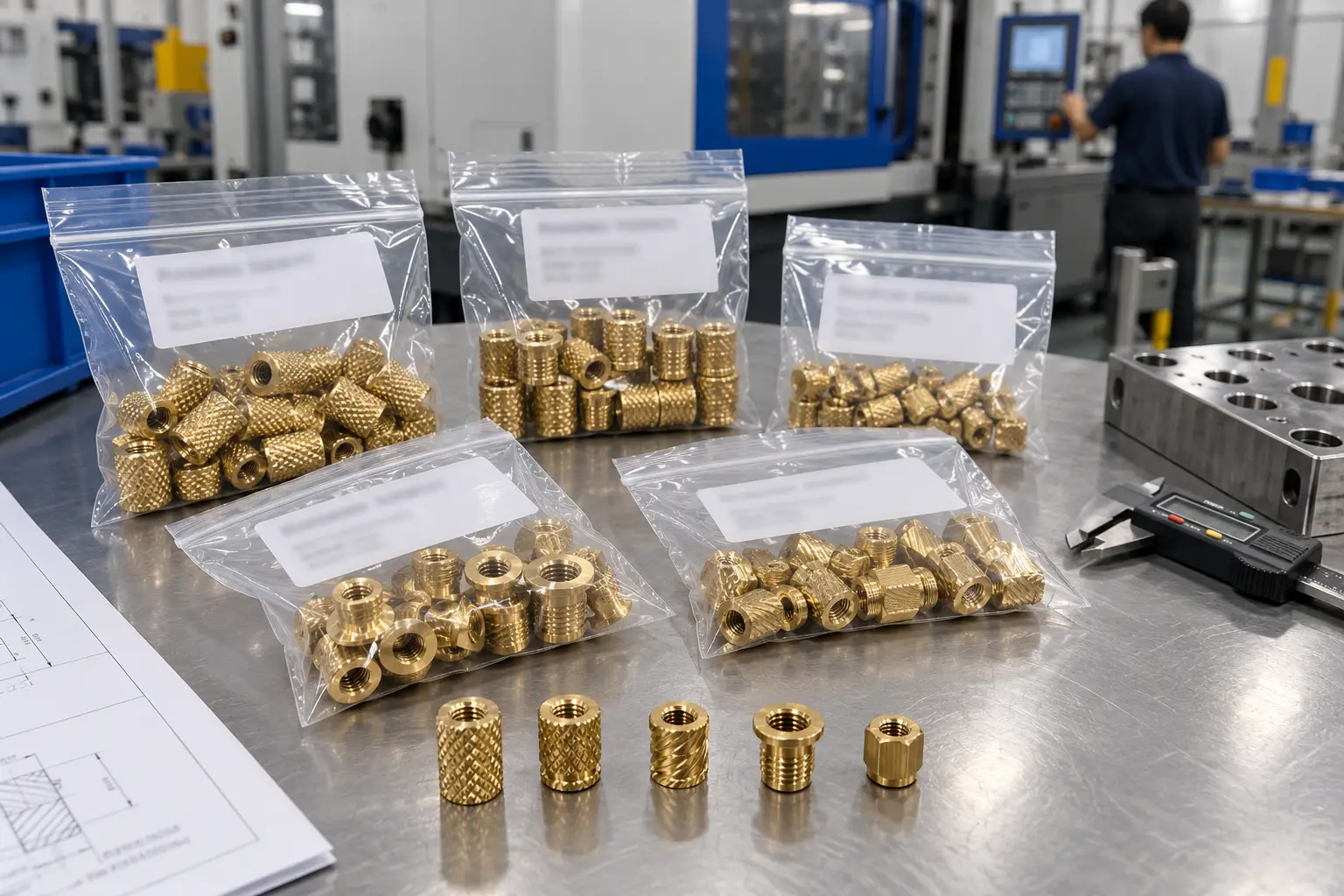
Samples let you test the combination in your own tool before you commit. Fenilo provides samples for assembly testing and quality evaluation, so ask for them in the first message.
Which commercial details make quotes comparable?
Quotes are comparable only when quantity, packaging and delivery terms are identical in every request. Include these items:
- Quantity per size: an order quantity for each part number, plus the annual volume you expect, since volume affects unit price.
- Order size limits: minimum order quantity depends on the product category and the customization required, so ask for it per part.
- Packaging and labeling: carton size, inner packs, label text and any barcode or lot marking.
- Incoterm and port: name the trade term and the destination. The ICC describes the Incoterms rules as clarifying the tasks, costs and risks involved in the delivery of goods from seller to buyer.
- Delivery date: give the date you need. Lead time is confirmed per order, so do not rely on a number from a web page.
Importers and distributors can start from the importers and distributors page, and molders from the pipe manufacturers page.
Which RFQ mistakes cost the most?
The costliest RFQ mistakes are incomplete information, because they turn into wrong samples and wasted weeks. Watch for these five:
- No drawing: a photo or a catalog code gives the supplier nothing to quote against.
- “Brass” as the material: without a grade, quotes mix leaded, low-lead and other brasses at different prices.
- Missing plastic or process: the knurl is designed for a resin and a process, so omitting them invites a mismatch.
- Unnamed market: a late request for market documents can force a grade change after samples are made.
- Different packages to different suppliers: if each supplier receives different data, the price comparison tells you nothing.
How does Fenilo review an insert RFQ?
Fenilo reviews each RFQ against the drawing, then discusses grade, knurl and samples before quoting. The factory in Yuhuan, Zhejiang runs hot forging, sandblasting, CNC machining, assembly and inspection under one roof.
- Hot-forged brass: inserts are made from CW617N (HPb59-1) brass bar, and hot forging avoids defects common in cast parts.
- Custom knurling: knurl pattern and size are customized to the injection process.
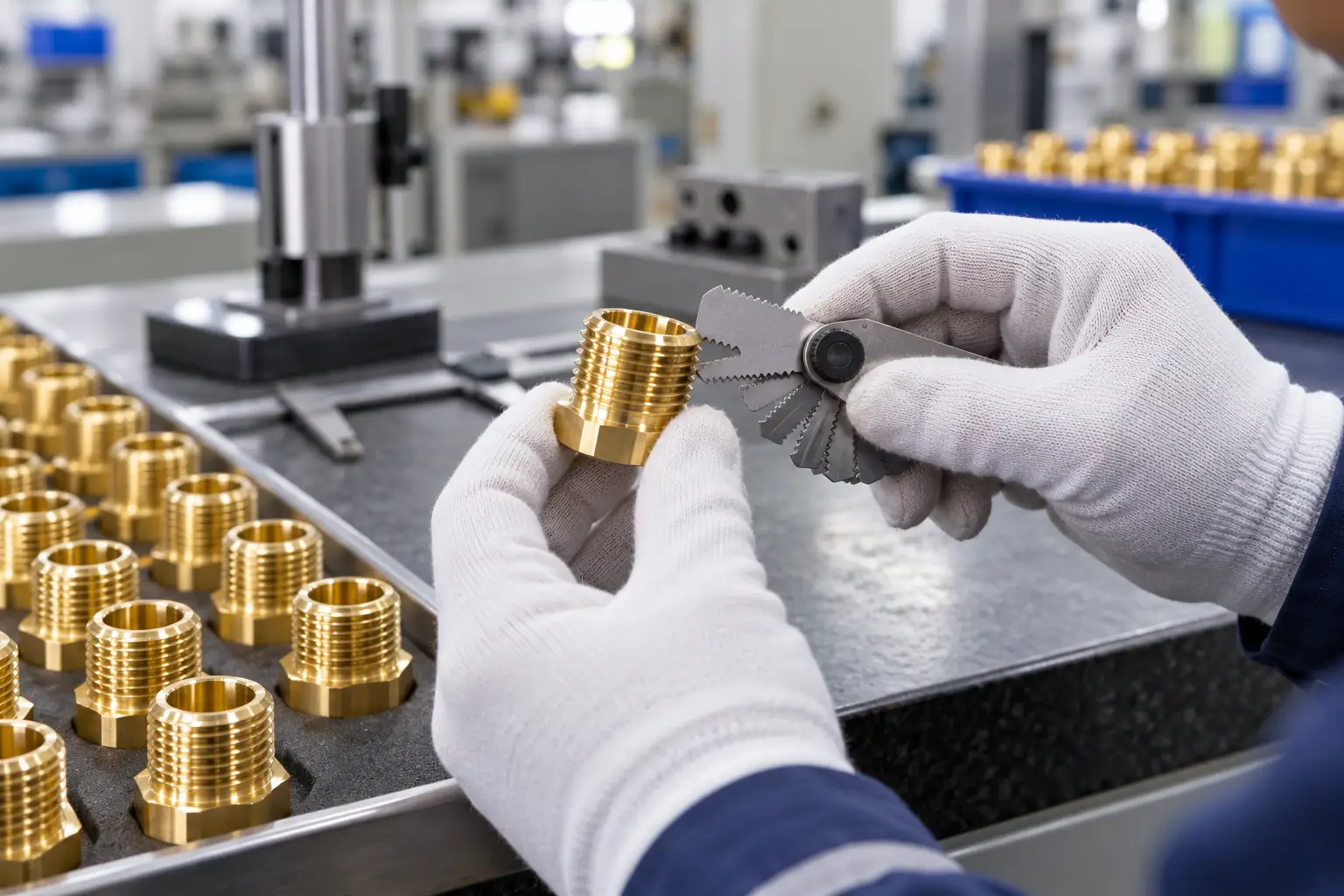
- Five-stage quality control: incoming inspection of all brass material, in-process dimensional checks, pressure and leak testing for valve products, finished-product inspection of appearance, thread, assembly and packing, and continuous improvement from production data and customer feedback.
- Samples: available for assembly testing and quality evaluation.
Ready to send your brass insert RFQ?
Send your drawing, target plastic, destination market and quantities to our team. We will review the drawing and discuss the grade, knurl design and sample options before quoting. Inserts are hot forged and CNC machined in our own plant in Yuhuan, Zhejiang, with five-stage quality control.
Send your RFQFAQ
What should a brass insert RFQ include?
A brass insert RFQ should include a dimensioned drawing, the brass grade, the thread callout with its standard, the knurl description, the target plastic and process, the destination market, and quantities with delivery terms. These items let a supplier quote without guessing.
Do I need a drawing to request a quote for brass inserts?
You need a drawing to request a reliable quote for brass inserts, because thread, knurl and tolerances cannot be priced from a photo or a catalog code. If you only have a sample, send it with the best dimensions you can measure and ask the supplier to confirm them.
Should I write tolerances in the RFQ?
Write tolerances on the drawing and refer to them as “per drawing” in the RFQ text. Keeping the values in one place avoids conflicts between the email and the drawing, and the supplier confirms them against the drawing before quoting.
Can I get samples of brass inserts before ordering?
You can get samples of Fenilo brass inserts for assembly testing and quality evaluation before a production order. Ask for samples in your first message, and run them through your own molding and pressure tests.
What is the minimum order quantity for brass inserts?
The minimum order quantity for brass inserts depends on the product category and the customization required. Fenilo does not publish a single number, so state the quantity per part in your RFQ and ask for the minimum for each.
Bottom line: write the RFQ so another engineer could quote it without calling you. Send one complete package to every supplier, name the market and the plastic, and test samples before you approve production.