
Two different certifications, two different questions. Here’s what each one actually checks — and why US-bound brass usually needs both.
Short answer: NSF/ANSI 61 tests whether a fitting leaches harmful substances into water. NSF/ANSI 372 tests whether the alloy’s lead content stays under the US legal limit. They measure different things, and most potable-water brass sold in the US needs both.
Key Takeaways
- NSF/ANSI 61 = leaching/health-effects test. NSF/ANSI 372 = lead-content calculation, capped at 0.25% weighted average.
- The 0.25% limit is US federal law (Safe Drinking Water Act §1417, effective 2014) — NSF 372 verifies compliance with it.
- Solder and flux have a stricter separate limit: 0.2%, not 0.25%.
- Common lead-free alloys: C87850, C69300. Traditional C36000 free-cutting brass (~2.5–3.7% Pb) does not qualify.
What Does NSF/ANSI 61 Actually Test?
NSF/ANSI 61 is a broad leaching standard. It doesn’t target lead specifically — it checks whether any wetted-surface material releases regulated contaminants into water above safe thresholds.
- Covers lead, arsenic, cadmium, chromium, copper, mercury, nickel, and other metals plus organics
- Tests the finished component under simulated water-contact conditions, not just the raw alloy
- Applies to plastic, rubber, and coated components too — not brass-specific
What Does NSF/ANSI 372 Actually Test?
NSF/ANSI 372 checks one thing: how much lead is in the alloy, using a weighted-average calculation across all wetted surfaces (the “Annex G” method) — not a leaching test.
- Pass threshold: 0.25% lead, weighted average, on wetted surfaces
- Verifies compliance with US Safe Drinking Water Act §1417, as amended by the 2011 Reduction of Lead in Drinking Water Act (effective January 4, 2014)
- Solder and flux face a stricter, separate limit of 0.2% (EPA)
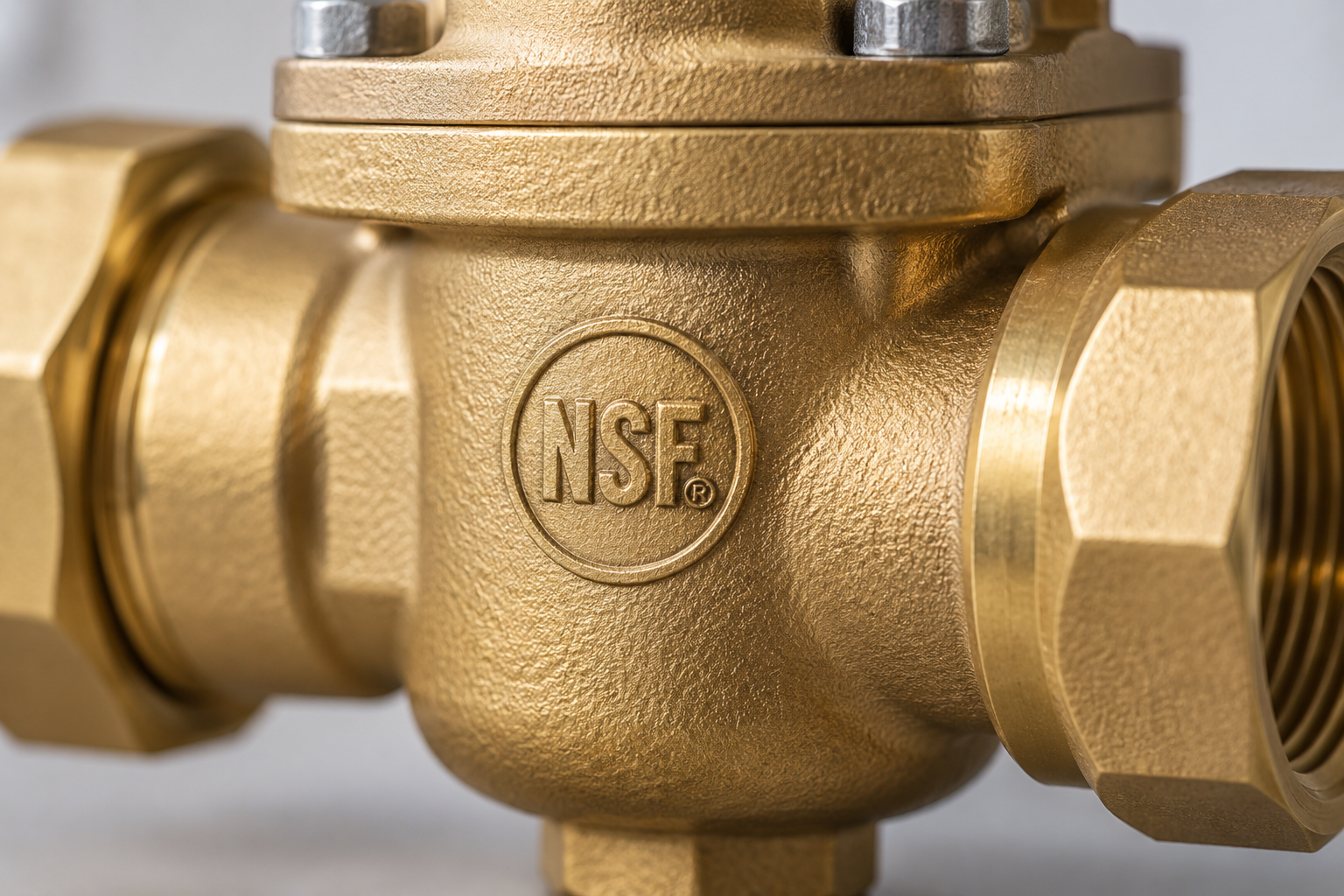
Do You Need Both Certifications?
For potable-water brass sold into the US, yes — in almost every case.
| Standard | What it proves | Required for US potable water? |
|---|---|---|
| NSF/ANSI 61 | Component doesn’t leach harmful substances | Yes |
| NSF/ANSI 372 | Alloy meets the 0.25% lead-content limit | Yes |
One certificate alone leaves a gap: a component can pass leaching tests while still using a leaded alloy over the legal limit, or vice versa. Always request both certificates for the exact SKU you’re ordering — certification is product-specific, not brand-wide.
Fenilo’s brass insert fittings and brass cartridges are available in both leaded and lead-free alloy options depending on your destination market.
Which Brass Alloys Are Actually Lead-Free?
- C87850 — silicon-bronze alloy, marketed as a lead-free replacement for leaded C93200, NSF/ANSI/CAN 372 compliant
- C69300 — silicon-brass alloy compliant with NSF/ANSI/CAN 61-2022 and the federal 0.25% rule
- C36000 (traditional free-cutting brass, ~2.5–3.7% lead) — good machinability, but does not meet the lead-free requirement for US potable-water parts
If a supplier quotes “NSF certified” without naming which standard, ask directly: 61, 372, or both? The answer changes what alloy you’re actually getting.
A practical look at how lead-free and leaded brass valves differ and when each is required.
Sourcing lead-free brass for the US market?
Fenilo manufactures brass inserts and fittings in its own plant in Yuhuan, Zhejiang, with hot forging, CNC machining and five-stage inspection under one roof. Material grade and the certification documents your destination market requires are discussed per project, so send the SKU and the target market with your inquiry.
Discuss your market requirementsFAQ
Is NSF/ANSI 372 the same as “lead-free”?
Effectively yes — it’s the certification that verifies a product meets the legal 0.25% lead-content definition of “lead-free” under US federal law.
Can a product be NSF/ANSI 61 certified but not lead-free?
Yes. NSF/ANSI 61 tests leaching, not lead content specifically, so a component can pass it while still exceeding the 0.25% lead-content limit. That’s why both certifications matter.
Does this apply outside the US?
The 0.25% rule is US federal law. Other markets use different frameworks — see our comparison of WRAS vs NSF certification for UK/EU vs US markets.
Bottom line: ask for NSF/ANSI 61 and 372 certificates by SKU, not by brand, before you ship brass fittings into the US. For a look at region-specific rules beyond NSF, see California AB 1953 and the 0.25% lead rule.