
The only real difference is the size of the hole through the ball. Here is what it changes in a water system, how to tell which valve you have, and how to specify it.
Short answer: A full port ball valve has a bore that matches the inside diameter of the pipe, so it adds almost no restriction. A standard port valve has a smaller bore, usually about one nominal size down, so it costs less and is more compact but adds some pressure drop. For most small water lines the difference is minor; for long runs, high flow or hot-water systems, full port is the safer choice.
Key Takeaways
- “Full port” and “full bore” mean the same thing: the ball’s hole is as large as the pipe’s inside diameter.
- Standard port (also called reduced port or standard bore) uses a smaller hole, which lowers cost and size and raises pressure drop.
- On short, low-flow branches the difference in flow is usually small, but on main lines and long runs it adds up.
- Published bore ratios and pressure-drop examples vary a lot between sources, so ask the maker for the bore diameter and a flow coefficient (Cv or Kv).
- For buyers, write “full port” and the bore diameter on the drawing and the RFQ so there is no guesswork.
What is the difference between a full port and a standard port ball valve?
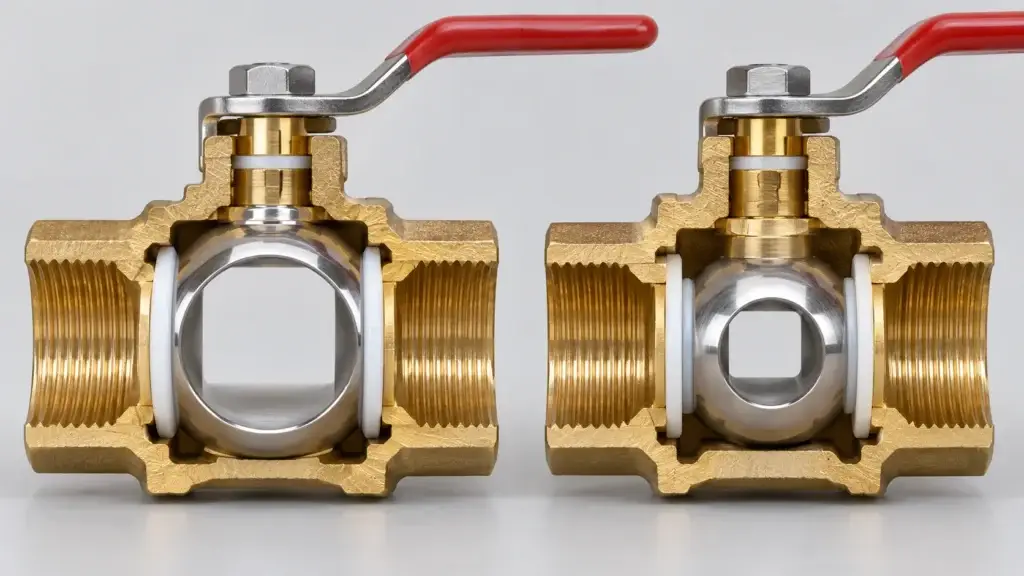
The difference is the diameter of the hole through the ball. In a full port valve the hole is as large as the pipe’s inside diameter; in a standard port valve it is smaller. Everything else, such as the body, the handle and the end connections, can look the same from outside.
| Feature | Full port (full bore) | Standard port (reduced bore) |
|---|---|---|
| Bore vs pipe | Same as the pipe’s inside diameter | Smaller, often about one nominal size down |
| Pressure drop | Very low | Higher, because the flow narrows through the ball |
| Flow capacity | Highest for the line size | Lower for the same line size |
| Size and weight | Larger body and ball | More compact and lighter |
| Cost | Usually higher | Usually lower |
| Best for | Main lines, long runs, hot-water circuits, anywhere flow loss matters | Short branches, tight spaces, cost-sensitive shut-off |
Sources do not agree on how much smaller a standard port bore is. One valve maker describes it as about one pipe size down, while another gives a range of roughly three quarters to nine tenths of the original size. The exact ratio depends on the maker and the size, so treat any single number as a guide, not a rule.
How much does port size matter in a water system?
Port size matters most where flow is high, runs are long or pressure is limited. On a short branch to one fixture, the difference between the two is often too small to notice.
- Main lines and risers: a restriction here affects every outlet downstream, so full port is the better choice.
- Hot-water circulation and heating loops: extra pressure drop makes pumps work harder, so full port helps.
- Short branch lines: standard port is usually fine and saves cost.
- Lines that carry sediment: a smaller bore can catch debris more easily, so full port reduces clogging risk.
- Tight installations: a standard port valve is smaller and may be the only one that fits.
Published pressure-drop examples differ widely between vendors, so do not take a single figure from a web page. If pressure drop matters to your design, ask the maker for the flow coefficient of the exact model and size.
How can you tell whether a ball valve is full port?
The most reliable way is to check the data sheet for the bore diameter or the flow coefficient. The handle and the body shape do not tell you. These checks help:
- Read the model data: look for “full port”, “full bore” or a bore diameter in millimetres.
- Compare bore to pipe: look through the open valve. If the opening is as wide as the pipe’s inside diameter, it is full port.
- Check the weight and size: a full port valve is usually larger and heavier than a standard port valve of the same pipe size.
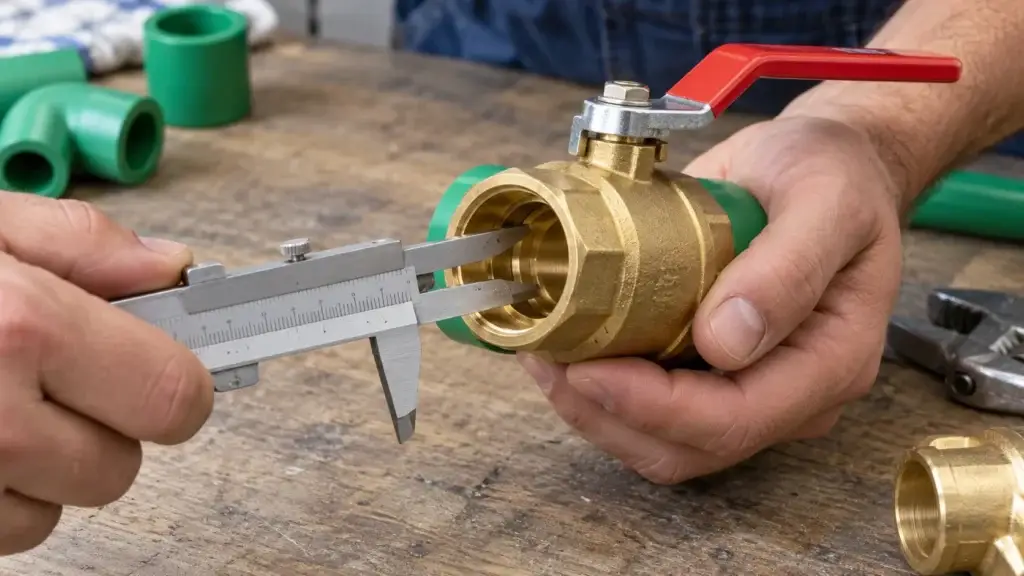
- Ask for a sample: measure the bore with a pin gauge or calipers before you order in volume.
Are PPR ball valves full port?
It depends on the maker, so check the model. Fenilo’s PPR ball valves use a full-port ball design to reduce pressure loss. Because PPR pipe walls are thick, the inside diameter is smaller than the outside size on the label, so a full-port PPR valve is matched to the pipe’s inside diameter, not to the nominal size alone.
See Fenilo’s PPR ball valve range for the sizes listed, and our guide to PPR fitting labels, PN and SDR for how pipe wall thickness relates to the markings.
What should buyers specify for port size?
Write the port type and the bore diameter in the drawing, the RFQ and the purchase order. A buyer who only writes “1/2 inch ball valve” may receive either type and have no basis for a complaint.
- Port type: state “full port” or “standard port” for each model.
- Bore diameter: give the minimum bore in millimetres and a tolerance.
- Flow coefficient: ask for Cv or Kv if pressure drop matters to the design.
- Test method: agree how bore and leakage are checked, and by what sample size.
- Labeling: decide whether the port type is marked on the body or the packaging, so distributors can tell the models apart.
Importers and distributors should also keep full port and standard port models as separate SKUs, because mixing them causes returns that look like a “weak flow” complaint. Our page for importers and distributors explains how we work with buyers.
How does Fenilo make its ball valves?
Fenilo hot-forges the brass body in CW617N / HPb59-1 and machines the ball, stem and threads on CNC equipment in one factory. The valve uses a precision-machined ball with PTFE sealing, a full-port design and double union connections.
- Inspection: every production batch is checked for pressure and leakage, and for dimensions and appearance.
- Customization: logos, colors, packaging and product configurations can be customized.
- Samples: samples are available for assembly testing and quality evaluation.
For a comparison of other valve types, see our page on the PPR stop valve range and the article on what a PPR stop valve is and where it is used.
Need full port ball valves for your range?
Tell us your sizes, connection types and bore requirements. Fenilo can supply samples for assembly testing and support OEM and ODM development, with delivery and order terms confirmed per order.
Contact FeniloFAQ
Is full port the same as full bore?
Yes, full port and full bore mean the same thing: the hole through the ball is as large as the inside diameter of the pipe. Reduced port, standard port and standard bore are also used interchangeably for the smaller design.
Is a full port ball valve better than a standard port?
A full port ball valve is better when low pressure drop and high flow matter, such as on main lines and hot-water circuits. A standard port valve is better where cost, size and weight matter more and a small flow loss is acceptable.
Does a standard port ball valve reduce water pressure?
A standard port ball valve adds some pressure drop because the flow narrows through the smaller bore. On short, low-flow branches the effect is usually small, while on long or high-flow runs it is larger.
How do I know if my ball valve is full port?
You know a ball valve is full port by checking its data sheet for “full port” or the bore diameter, or by comparing the opening through the open valve to the pipe’s inside diameter. The handle and body shape alone do not tell you.
Should I use full port valves for hot water?
Full port valves are the safer choice for hot-water circulation and heating loops, because the lower pressure drop reduces the work the pump has to do. Check that the valve’s materials and ratings suit the temperature.
Bottom line: Full port means the ball’s hole matches the pipe; standard port means it is smaller. Choose full port for main lines, long runs and hot-water circuits, and write the port type and bore on every drawing and order.